Channel marketing automation has become table stakes for global partner ecosystems. The question for technology leaders today isn’t whether to automate. It’s whether automation alone is enough to drive the partner engagement, partner demand generation, and channel revenue growth your program needs.
For VPs and Sr. Directors of Channel Marketing managing complex partner networks, channel marketing automation solves real problems: manual workflows, content sprawl, localization bottlenecks. Whether you call it channel marketing automation, through-channel marketing automation (TCMA), or partner marketing automation, the category has matured, and as ecosystems scale, the limits of automation-era thinking become visible. Logins go up. Pipeline doesn’t.
Below are nine capabilities to evaluate in any channel marketing automation platform and the diagnostic cues that separate platforms built for automation from platforms built for execution. If you’re running a platform comparison for technology companies with global partner ecosystems, use this as your shortlist filter.
1. Faster campaign launch across the partner base
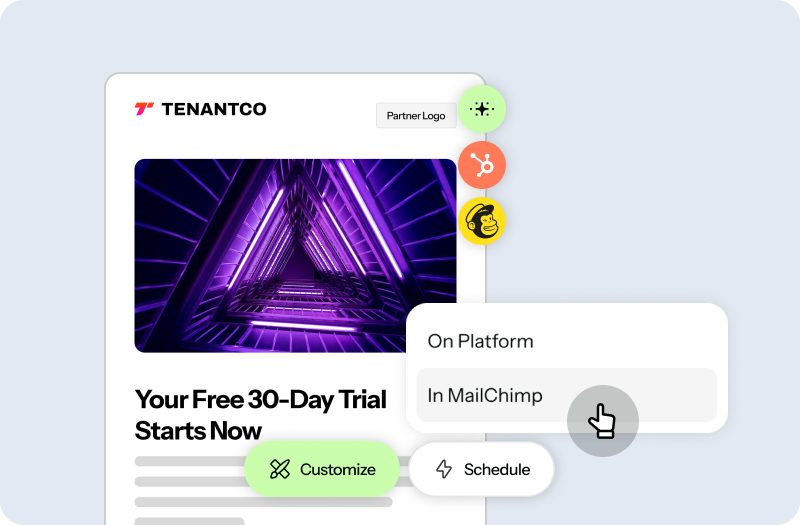
Channel marketing automation replaces the email-and-attachment cycle with templated campaigns partners can deploy in a few clicks. For global ecosystems with hundreds or thousands of partners, that compression of time-to-launch is the most immediate, measurable win.
Evaluation cue: Ask vendors how long it takes a new partner to launch their first campaign end-to-end. If the answer is measured in days rather than minutes, you’re looking at a content repository with an automation layer, not a true execution platform.
2. Scalable content personalization for partner engagement
Through-channel marketing automation (TCMA) lets vendors push approved content into partner-led campaigns while preserving brand integrity. Done well, it eliminates the tradeoff between consistency and relevance. That’s the foundation of meaningful partner engagement at scale.
Evaluation cue: Personalization that requires partners to manually edit fields isn’t personalization. It’s templating. Look for AI that adapts content by partner tier, region, industry, and solution focus without partner effort.
3. Localization at global scale
For enterprises scaling global partner ecosystems across EMEA, APAC, and the Americas, manual translation is a hard ceiling on growth. Channel marketing automation that handles 100+ languages instantly turns localization from a quarterly bottleneck into a real-time capability.
Evaluation cue: Native AI translation across 130+ languages should be standard for any platform serving global ecosystems. If localization is positioned as a services engagement or a roadmap item, it’s not enterprise-ready.
4. Higher partner adoption and engagement
The data is consistent across the category: most partner portals see single-digit active engagement. Channel marketing automation that reduces friction through fewer logins, fewer training videos, and fewer manual handoffs directly correlates with adoption.
Evaluation cue: Ask for engagement benchmarks. Two-thirds of partners remaining active and engaged is meaningfully above industry norms. Anything in the 10–20% range is the category baseline.
5. Reduced operational load on the channel team
Every content request, localization ticket, and campaign assembly task that channel marketing automation absorbs is time the channel team can redirect to strategy, partner relationships, and revenue analysis. The TCO case is rarely about software cost. It’s about headcount avoidance.
Evaluation cue: Quantify the manual tasks automation will eliminate before procurement. If the platform requires a dedicated admin team to operate, the operational savings are illusory.
6. Compliance and brand governance at scale
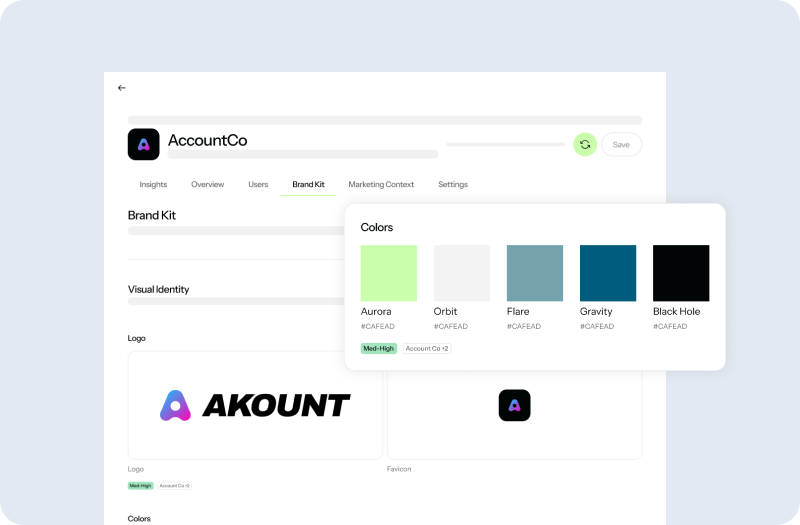
For enterprises in regulated industries or with strict brand standards, channel marketing automation provides locked sections, controlled edit zones, and approved-asset libraries that human review cycles can’t match. Governance becomes a property of the system, not a manual checkpoint.
Evaluation cue: SOC 2, GDPR, and SSO are baseline. The deeper question is whether the AI layer is trained exclusively on your approved content or whether it pulls from external sources that introduce brand and compliance risk.
7. Multi-channel campaign execution
Modern channel marketing automation extends beyond email into social (LinkedIn, Meta), web (WordPress and CMS integrations), and paid media. Partners who can launch a coordinated multi-channel campaign without leaving the platform engage at materially higher rates than partners managing channels separately. That’s where partner demand generation actually starts to compound.
Evaluation cue: Count the channels supported natively versus via integration. Native execution is faster, more reliable, and easier for partners to adopt than stitched-together workflows.
8. Pipeline visibility and revenue attribution
This is where most channel marketing automation hits its ceiling. Most platforms report on engagement metrics like downloads, logins, and opens because that’s what their architecture captures. Channel marketing leaders increasingly need pipeline value, realized revenue, and partner-tier contribution to defend budget, prove channel revenue growth, and earn a seat at the revenue table.
Evaluation cue: If the reporting suite stops at engagement, partner marketing will continue to be measured as a cost center. Look for lead management reporting that connects partner activity to opportunity value and closed revenue.
9. A foundation for what comes next: partner marketing execution
Channel marketing automation solved the throughput problem. The next problem, the one driving partner demand generation and channel revenue growth in 2026, is execution: turning partner intent into market-ready campaigns without partners navigating systems, filtering content libraries, or learning new tools. This is where the category is shifting from Partner Marketing Automation to Partner Marketing Execution (PMEP).
Evaluation cue: The platforms leading this shift are AI-native, not AI-overlay. They’re built around partner intent (“I want to run a campaign for mid-market financial services”) rather than partner navigation (“Find the campaign in folder 3, version 2, EMEA-localized”). Any serious platform comparison for technology companies should center on this distinction.
Automation is the floor. Execution is the ceiling.
Every capability on this list is real. Channel marketing automation has materially improved how global partner ecosystems operate, and any technology company scaling indirect revenue should treat it as foundational.
But the leaders building durable channel revenue growth in 2026 are looking past automation toward execution: platforms that activate every partner, prove every dollar, and give partner marketing a seat at the revenue table.
Structured’s AI engine lets partners describe what they need in natural language and receive brand-compliant, personalized content in minutes. A partner in Germany can ask for a localized version with GDPR-compliant language. A partner selling to healthcare can request industry-specific proof points. No request tickets. No queues. No waiting.
See how Structured turns partner intent into automated execution across your global partner ecosystem.