Calculating the return of partner marketing activation to revenue per partner.
By Maureen Beckman, Director of Product Marketing, Structured
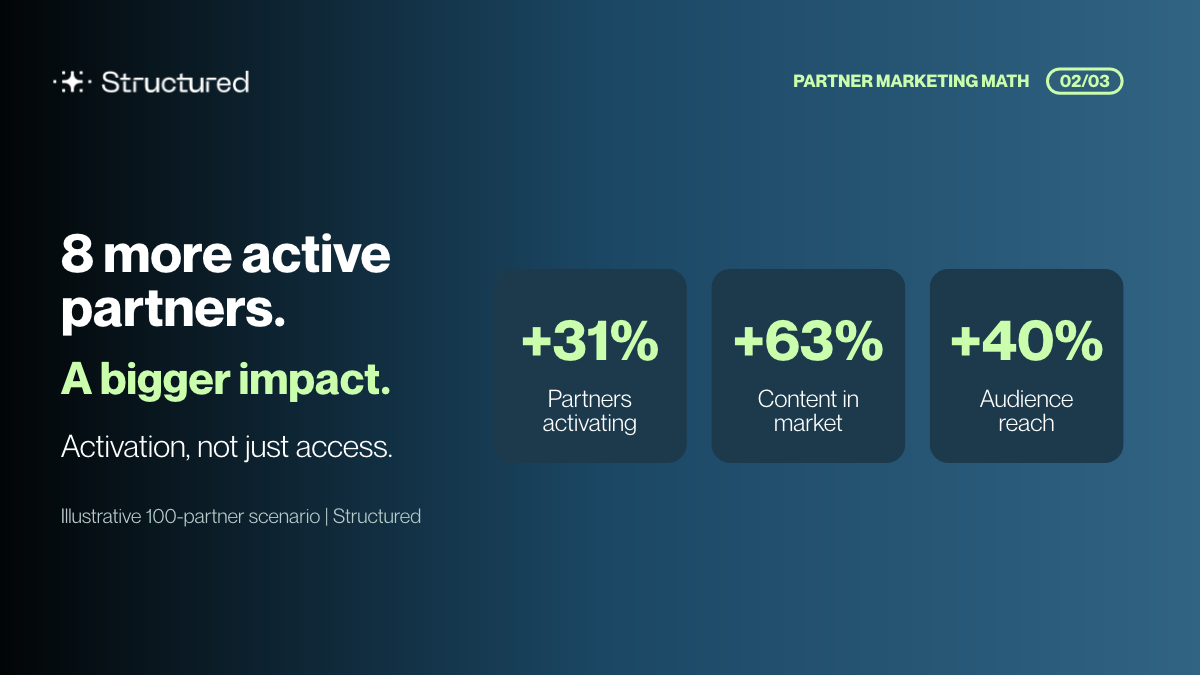
In Part 2 of this “Partner Marketing Math” series, I looked at what happens when a few more partners out of every hundred put your content to market: more content in the field, and more people seeing it. This post follows that through to revenue.
The measure I’ll use is revenue per partner, which is total partner revenue divided by the number of partners in your program. Many channel leaders are evaluated on it because it reflects how productive a partner base is, something partner counts and partner portal login numbers don’t show.

Why recruiting alone doesn’t raise it
When companies look to the channel to drive more revenue, the first instinct is often to recruit more partners. That adds coverage, but if new partners end up as inactive as many existing ones, revenue per partner goes down. Raising it depends on activation: more of your current partners putting campaigns and your content in front of their customers, and coming back to do it again.
Walking through the math
Our product team has been studying partner behavior across our customer base, which includes companies like Microsoft, Dell, ServiceNow, Google, Klaviyo, Nutanix, and Arrow. A few patterns are consistent. About four in five partners who come looking for content find something they want to use. Partners who use the AI natively built into the platform use almost five times as much content as those who don’t, and they’re twice as likely to come back within 30 days. In one program, 80 long-tail partners sent more than 223,000 emails in their first few months.
To see what that kind of activity is worth, take a program where 100 partners come to the content library in a typical month. Based on what we see across customers, about 26 of them would put content to market without an AI-native platform, and about 34 would with Structured. Say each partner’s marketing list reaches about 250 people. Those eight extra partners, plus the more active partners coming back to send again, mean your content reaches roughly 2,750 more people a month, or about 33,000 more over a year.
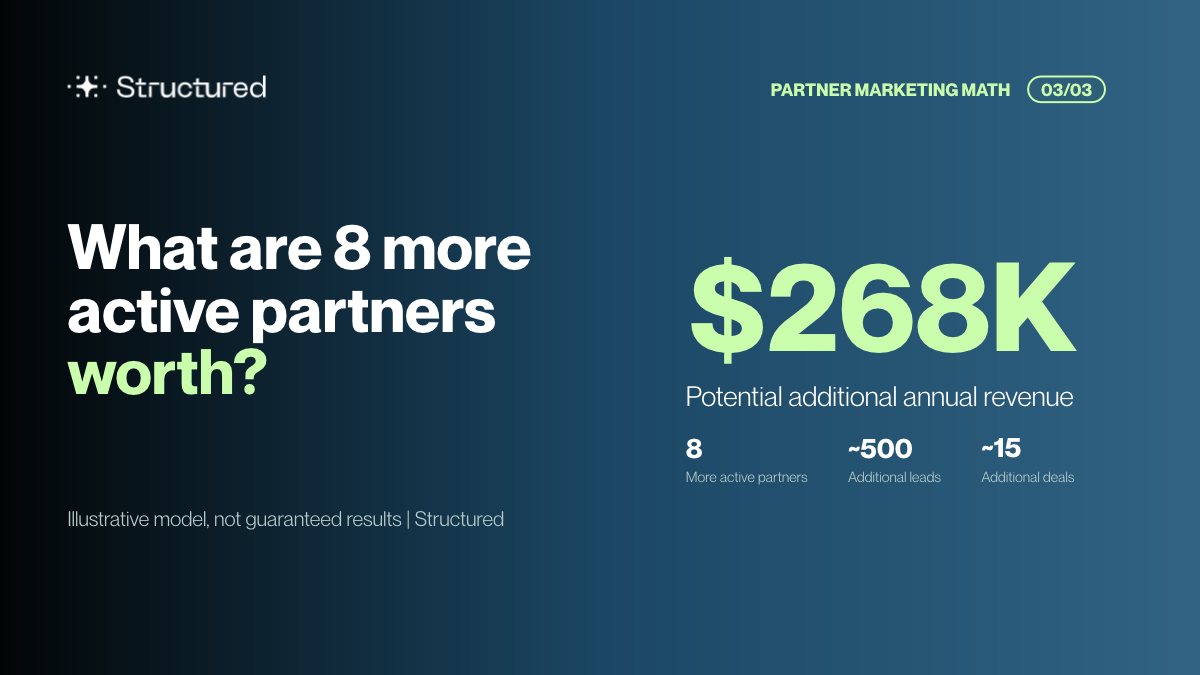
Say 1.5% of those people respond and become leads. For context, B2B email campaigns average around 2.5%. Over a year, that comes to about 500 more leads.
Now say 3% of those leads become closed deals. Benchmarks for B2B leads run from about 2% to 5%, and deals that involve a partner tend to close more often than cold, direct ones. That’s about 15 more closed deals a year.
At an average deal size of $18,000, those deals add up to roughly $268,000 in new revenue a year. Spread across 100 partners, that’s about $2,700 more revenue per partner, per year.
Your own numbers will change the result. On the same assumptions, a program with 1,000 active partners would see about $2.7 million, and larger deal sizes would raise it further.
Where the leverage is
Walking through it this way makes it easier to see which inputs a channel team can influence. Deal size and close rate are mostly set by your business. Channel teams control the top of the funnel: measuring how many partners put your content into market, and how often. Every step after that builds on it.
That’s also where the AI makes its difference. Partners who use it work with more content and come back more often, so each of them adds more at the start of that chain.
Growing revenue from the partners you have
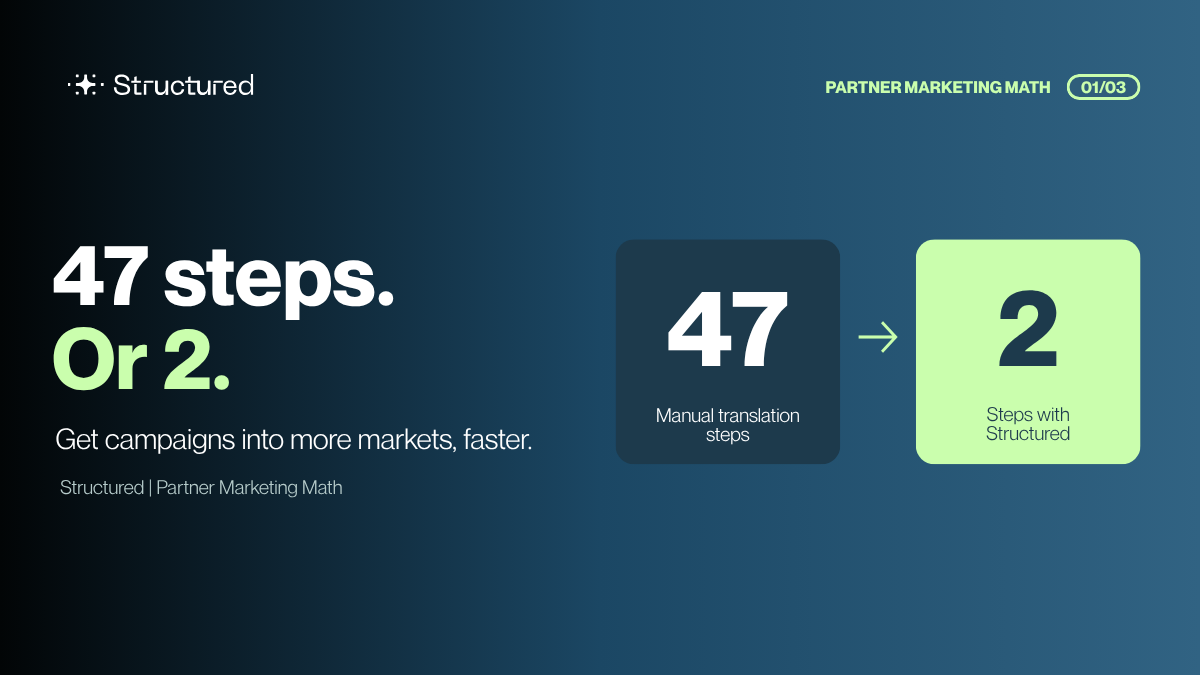
The value of partner marketing done well shows up in many places. Less manual work for your team to build content that’s easily accessible to your partners sooner, in every market, makes partners more capable of using it. And more active partners, with more content and demand building pipeline, is what increases revenue per partner over time.
For most programs, the fastest way to grow partner revenue is to activate more of the partners already in your base.
If you’d like to see how your team can do this, book a call. We’ll show you Structured, the AI-native partner marketing automation platform, and how it helps you grow revenue from the partners you already have.