Global partner networks are a growth engine. They’re also a localization headache. Vendors need partners to reach buyers in local markets, but those markets require content adapted for different languages, cultural norms, and regulatory environments. The challenge is enabling partner content localization without losing control of the brand. Structured met this challenge head on when designing its AI-native platform.
Most vendors make the same mistakes over and over again.
1. Treating translation as localization
Word-for-word translation is the bare minimum, and it’s rarely enough. A tagline that resonates in English may fall flat or cause confusion in German. Idioms don’t translate. Cultural references miss the mark. Dates, currencies, and number formats all need adjustment. Effective localization adapts the content for the market, not just the language. That means rethinking examples, proof points, and even the structure of the argument to match local buyer expectations.
2. Ignoring regional compliance requirements
Regulatory environments vary widely. A campaign referencing U.S. data privacy standards means nothing to a buyer in the EU who cares about GDPR. Healthcare content targeting German hospitals needs different compliance language than content for U.S. health systems. Financial services, government, and other regulated sectors compound this complexity. Vendors who skip compliance localization put their partners in an awkward position: deploy content that feels off, or don’t deploy it at all.
3. Allowing inconsistent messaging across regions
When localization is handled ad hoc, messaging fragments. One partner in France uses outdated positioning. Another in Brazil emphasizes the wrong product benefits. A third in Japan creates entirely new claims that the vendor never approved. Over time, the brand story becomes incoherent. Prospects in different markets encounter different versions of the company, and none of them align with the vendor’s core narrative.
Why Not Just Let Partners Localize on Their Own?
When vendors don’t provide localized content, partners fill the gap themselves. This seems efficient until you see the results: off-brand visuals, unapproved claims, outdated messaging, and compliance language that legal never reviewed.
Partners aren’t trying to cause problems. They’re trying to sell. But without guardrails, DIY localization creates risk. Brand equity erodes. Legal exposure increases. And the vendor loses visibility into what’s actually being said in the market.
The alternative, forcing partners to submit every localization request for manual approval, creates bottlenecks that slow campaigns and frustrate partners. Neither extreme works.
Which Guardrails Make Partner Localization Scalable?
Effective localization at scale requires a system, not a process. That system should include:
Pre-approved localization parameters. Define what can be adapted (language, regional examples, compliance language, currency) and what stays fixed (core messaging, product claims, brand voice). Partners get flexibility within boundaries.
Centralized content with localized outputs. Start with a single source of truth. Generate localized versions from that core, so updates flow through automatically and nothing drifts out of sync.
AI-powered adaptation with brand guardrails. Manual localization doesn’t scale. AI does, but only if it’s trained on your brand guidelines, messaging framework, and compliance requirements. Structured’s AI engine delivers localized content that’s on-brand by default.
Visibility and auditability. Vendors should take the time to see what content partners are deploying and in which markets. This isn’t about control for its own sake. It’s about catching problems early and understanding what’s working.
Localize Channel Marketing Content at Scale
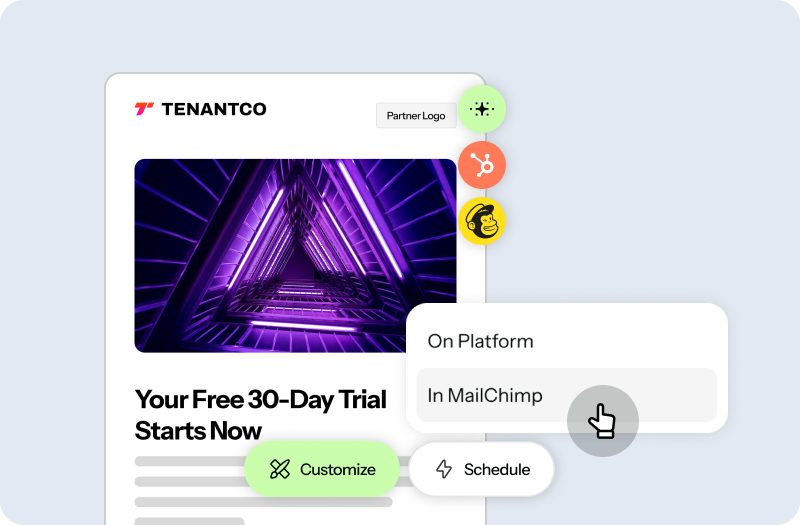
Structured’s AI engine was built to solve the whole localization problem. Partners describe what they need in natural language: “Localize this for Germany, translate into German, and update the compliance language for GDPR.” The AI delivers a brand-compliant, localized asset in minutes. No request tickets. No approval queues. No waiting.
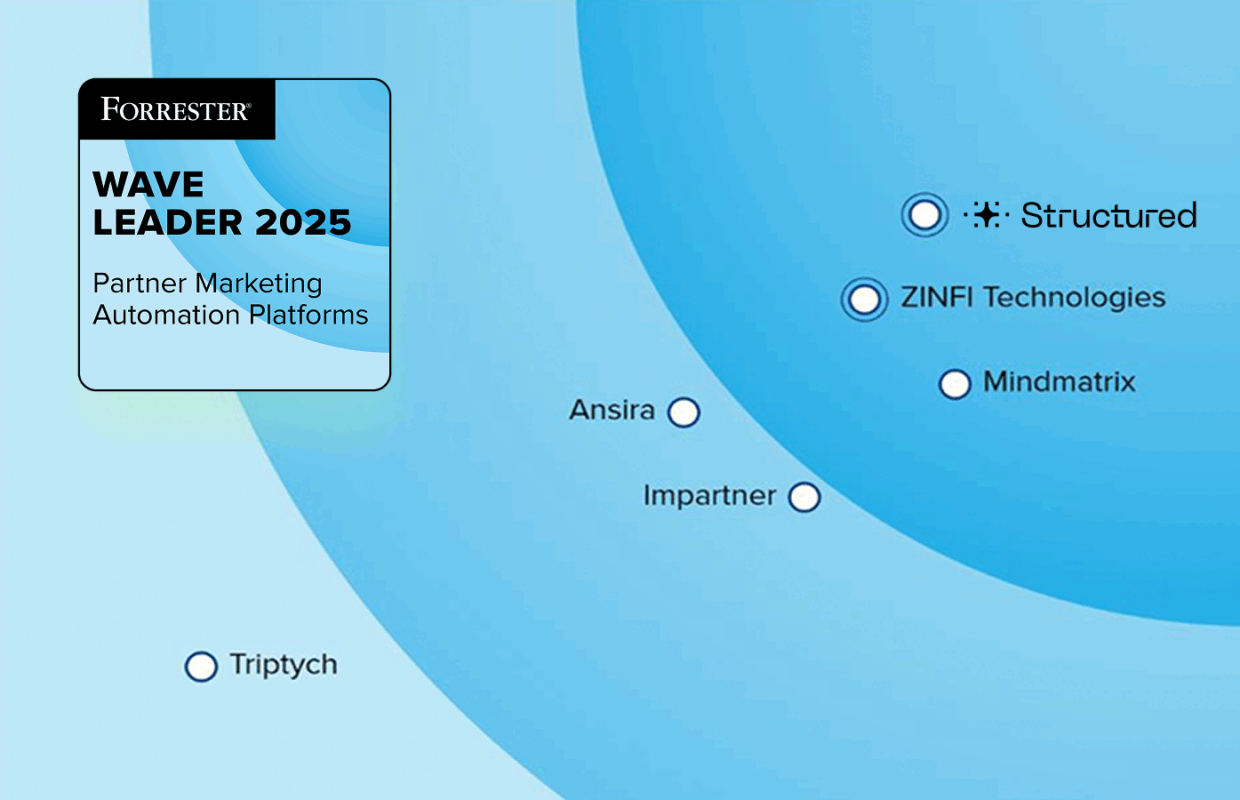
This is the approach that earned Structured the highest possible score in Customization, Localization & Personalization in The Forrester Wave for Partner Marketing Automation Platforms, Q2 2025. It’s how leading enterprise tech vendors are activating their partner ecosystems today.
Partner localization is one dimension of what we call the PRISM framework: a model for thinking about partner content personalization across five dimensions, from co-branding to account-level customization. Localization is the R in PRISM, and for global vendors, it’s often the highest-impact place to start.