PART ONE OF THREE
When Everything Is Available and Little Gets Launched
On paper, most enterprise partner programs look ready to perform. Partners are recruited and onboarded. The campaign library is stocked, the portal is live, MDF is funded, and enablement sessions are on the calendar. Every input a partner needs to go to market is in place.
Then the quarter plays out. Campaigns sit ready but unlaunched. Co-branded assets go untouched. The program looks well resourced from the inside while underperforming on the metric that matters most: how many partners actually take campaigns to market.
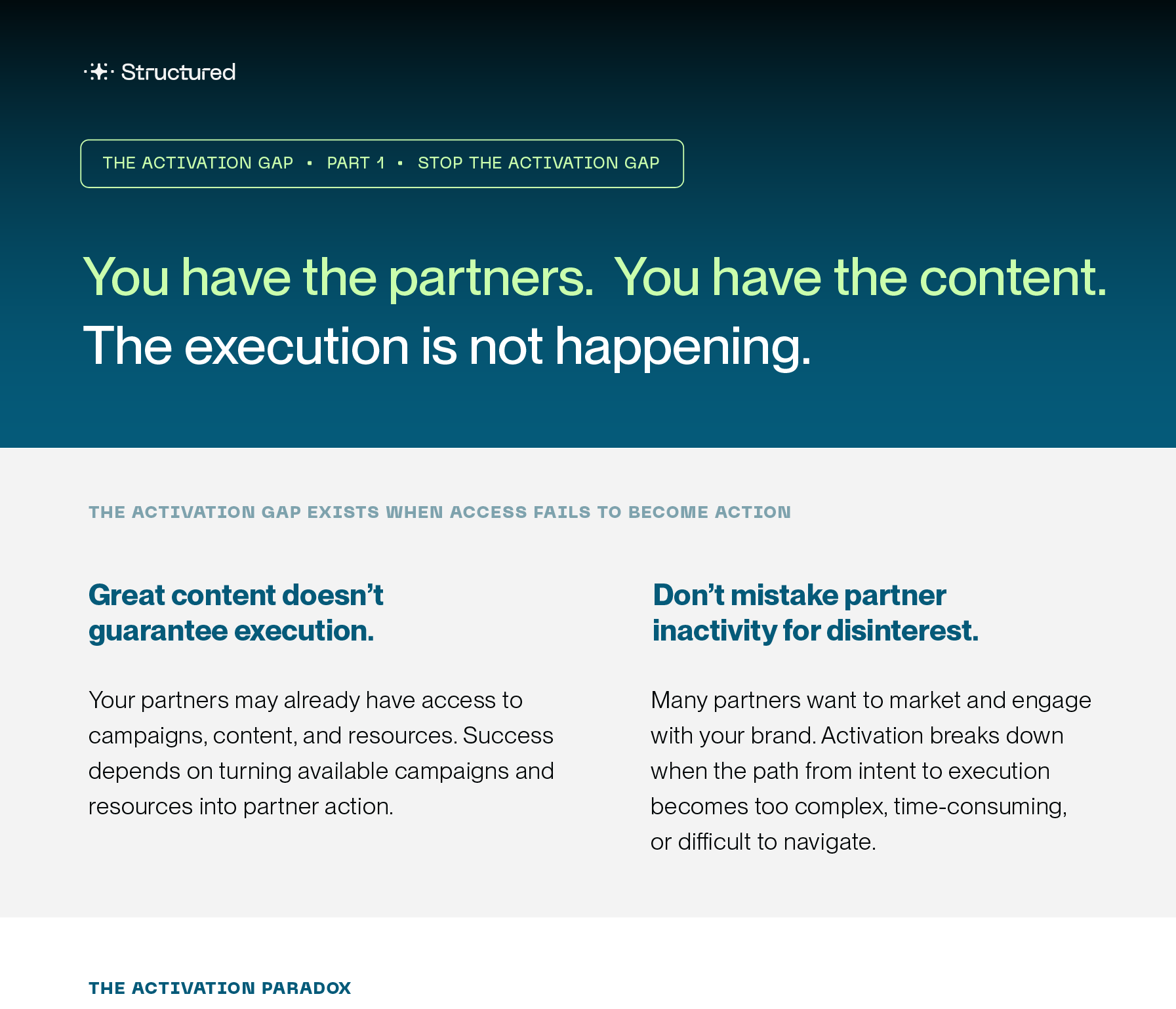
This is the activation gap, and it comes down to one idea: access is not activation.
Handing partners campaigns, content, and resources gets them to the starting line. Whether they take those materials to market is a separate question, and it is the one many programs never quite answer. The cause is rarely weak content and almost never low commitment. It is operational: the route from portal to market is harder to travel than anyone intended.
What the Activation Gap Actually Is
The activation gap is the distance between what partners can do and what partners actually do.
A partner who is onboarded, credentialed, and given access to a full campaign library is, in theory, ready to go. In practice, a series of steps still stands between “the campaign exists” and “the campaign is live”: finding the right campaign, working out how to customize it, adapting it for their audience, setting it up in their own systems, and fitting all of that around the other vendors asking for the same attention.
Each step is a place where a launch can quietly die. The gap rarely comes from a single failure. It builds up through small obstacles that, added together, make launching harder than it needs to be.
Put simply, access describes what the program has made available, and activation describes what partners have done with it. Channel teams often measure and celebrate the first while the second lags behind.
Why More Content Does Not Close the Gap
When launches stall, the usual response is to produce more. More campaigns, more assets, more templates, more enablement sessions. The logic is understandable: if partners are not launching, maybe they are missing something.
But when partners already have campaigns they are not using, adding more can compound the problem if the path to launch stays unclear. A larger library takes longer to search. More options mean more decisions. A partner who was already unsure where to start now has even more to sort through before taking the first step.
This is the activation paradox. Partners plus content should equal launches, but often they do not. Volume was never the constraint. What partners are missing is a short, obvious route from deciding to run a campaign to actually running it.
The Real Bottleneck Is the Path, Not the Assets
Consider who is on the other end of your program. Many partner marketing teams are one or two people supporting five or six vendor relationships at once. When they decide to run a campaign with your brand, that decision is real. What happens over the following week determines whether it survives.
If the next step means hunting through a portal, decoding a forty-slide enablement deck, rebuilding assets in their own tools, or waiting on an approval, the decision has to compete with the effort. The partner has not stopped caring. The path has simply grown longer than the time they have. The campaign that was going to launch this week becomes next month’s task, and then nobody’s task.
What Channel Teams Often Get Wrong
Three assumptions tend to keep the activation gap open.
Mistaking Inactivity for Disinterest
When partners go quiet, it is tempting to conclude they are not committed. Most joined the program for a reason and genuinely want to market with your brand. Before writing a quiet partner off, look at where they stopped. Are they stuck choosing a campaign, waiting on an approval, working through localization, or lost in configuration? Each answer points to a different fix, and none of them is a motivation problem. Treating low activation as a commitment issue leads to the wrong remedies, usually more incentives or more recruitment, when the barrier is operational.
Measuring Availability Instead of Activation
Programs often report on what has been built and distributed: campaigns published, assets uploaded, partners onboarded. These are inputs. A team can hit every one of those milestones while partner launches stay flat. The more telling questions sit downstream. How many partners launched? How quickly after gaining access? What happened as a result?
Assuming Onboarding Equals Readiness
Onboarding confirms a partner can get in. It does not confirm they know which campaign to run first, how to adapt it, or what a good launch looks like. Readiness is an ongoing state rather than a one-time checkbox, and it erodes every time the program changes and the partner’s understanding does not keep up.
What to Do Differently
Closing the activation gap starts with a shift in focus: from making resources available to removing the obstacles between resources and launch.
- Map one campaign end to end. Choose a flagship campaign and document every step a partner must take to get it live: the logins, the searches, the edits, the approvals, the systems they have to move between. Count the steps. Most teams are surprised by the total, and the map shows exactly where to start cutting.
- Shrink the decision surface. Rather than presenting the full library, point each partner toward two or three recommended campaigns based on their segment, market, or maturity. A clear starting point beats a comprehensive catalog.
- Measure launches, not just logins. Track how many partners run a campaign, and how long a newly onboarded partner takes to run their first one. If those answers are unclear or discouraging, the gap is structural, and more content will not fix it.
- Design for the partner’s real capacity. Campaigns should be executable by a small partner team with limited time, not only by a full marketing department. If launching requires skills or hours most partners do not have, the campaign is built for a level of capacity they cannot give it.
- Follow up while the decision is fresh. When a partner shows interest in a campaign, help them take the next step within days, not through a generic reminder three weeks later.

WATCH THE WEBINAR
If partners have everything they need and campaigns are still not going live, the activation gap is at work. Watch the Activation Gap webinar to see why some partner programs consistently drive execution while others struggle to activate partners.
Practical Takeaways for Channel Marketing Teams
- Adopt “access is not activation” as the working principle for evaluating your program.
- Pick one campaign this quarter and map every step a partner must complete to launch it.
- Report launches and time-to-first-launch alongside your availability metrics.
- When a partner goes quiet, check where they stopped: campaign selection, approvals, localization, or configuration.
- Remove one launch obstacle per quarter and watch what changes.
Turning Access into Action
The activation gap is not a verdict on your partners or your content. It is a sign that the path from access to action is harder than it should be. The programs that consistently get campaigns into market are rarely the ones with the biggest libraries. They are the ones where launching is the easiest thing a partner can do.
For channel teams, that reframing changes the work. The question stops being “what else can we give partners?” and becomes “what is standing between partners and a launch, and how do we remove it?”
In Part 2, we’ll look at where activation really starts to break down: The Setup Tax: Why Partners Stall Before Campaign Launch.