Artificial intelligence is changing marketing in ways that go well beyond generating copy or images.
Marketing teams are using AI to make sense of data, personalize experiences, automate repetitive work, and get campaigns out the door faster. For companies that rely on partners to bring products to market, there’s another opportunity: making marketing easier for those partners to execute.
After all, having great content available doesn’t mean partners will use it. They still have to find the right resources and adapt them to fit their needs.
The most effective AI-driven marketing strategies make it easier to turn a marketing strategy into action.
What Are AI-Driven Marketing Strategies?
AI-driven marketing strategies use artificial intelligence to improve how organizations plan, execute, and measure their marketing.
Predictive AI can find patterns in historical data, while generative AI can create or adapt marketing materials. AI agents go further by taking actions and moving work through a process.
Why AI Matters for Partner and Channel Marketing
Partner marketing comes with an execution challenge that centralized marketing teams don’t face in quite the same way.
The vendor owns the product and sets the broader brand and marketing strategy. Partners are independent businesses that bring those products to market through their own customer relationships.
So, the vendor can create a great campaign without being the one that ultimately executes it.
Before a partner can put that campaign into market, they may need to find the right materials and figure out how to use them. They might need to add their own branding or tailor the messaging for a particular audience. Global partners may need localized materials.
Every extra step creates another place for execution to stall.
AI gives vendors a way to reduce that friction. Instead of simply giving partners more content, they can make it easier to get the right content into a partner’s hands and turn it into an active campaign.
AI-Driven Marketing Strategies: 7 Ways AI Is Changing Partner Marketing
There are plenty of ways to bring AI into marketing. That doesn’t mean every one of them belongs in your marketing strategy.
The best place to use AI is where it solves a real problem. Here are seven strategies that can make a meaningful difference in how marketing gets planned, executed, and measured.
1. Turn Marketing Data into Action
Most marketing teams aren’t short on data. Making sense of it is another story.
AI tools can analyze campaign activity, marketing data, engagement patterns, and customer data far faster than someone working through individual reports. Predictive analytics can find patterns in historical information and use them to shed light on what may happen next.
But analysis is only valuable when someone can act on it.
2. Personalize Marketing at Scale
Personalization gets harder as the number of audiences grows.
AI can make that work more manageable by adapting marketing based on relevant signals. A campaign might need different messaging for a particular industry or market, for example. Customer behavior can also provide useful context.
The challenge to personalize campaigns grows in a large partner ecosystem.
One vendor may work with hundreds or thousands of partners. Those businesses don’t all look alike. They may serve different markets or specialize in different areas. Each also has its own brand and customer relationships.
Sending all of them the exact same campaign puts much of the adaptation work back on the partner.
AI-driven personalization gives vendors another option. Centrally developed marketing can be adapted to make it more useful to an individual partner without rebuilding every campaign by hand.
There should still be boundaries. Brand standards and approved messaging should be protected.
The goal is to give partners useful flexibility without asking them to start from scratch.
3. Make Marketing Content Easier to Find and Use
Sometimes there isn’t a content shortage. There’s too much of it.
A company may have years of campaigns, templates, graphics, guides, and other approved resources tucked into its content library. Then a partner needs something for a specific opportunity and has no idea what to search for.
Finding one asset can turn into a time-consuming tour of folders or menus.
Natural-language AI changes the experience. Users can simply describe what they’re trying to accomplish. They don’t have to know the name of the asset or remember where it was stored.
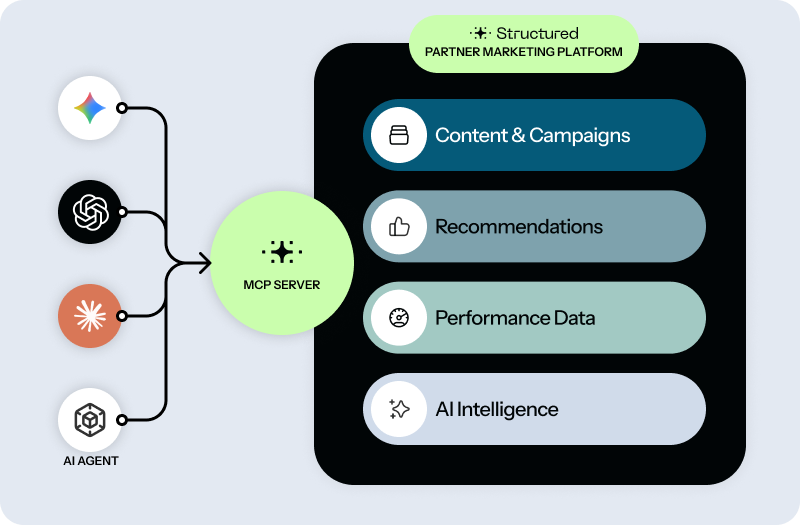
Structured brings this approach to partner marketing execution. As an AI-native partner marketing execution platform, it helps partners access and activate approved marketing resources without navigating complicated systems.
4. Accelerate Campaign Creation Without Sacrificing Brand Control
Generative AI can take a lot of manual work out of campaign creation.
It can provide a starting point for a new campaign, create variations, or adapt existing materials for a different audience. Work that once involved several requests and handoffs can move much faster.
For an enterprise brand, though, faster isn’t automatically better.
AI-generated content can drift away from approved messaging. It can introduce inaccurate claims or create compliance concerns. And when independent partners are executing under a vendor’s brand, those problems can multiply quickly.
That’s why guardrails need to be part of the strategy.
AI should work from approved materials and established brand standards. Teams also need to decide which actions require human review and which can happen without approval.
For partner marketing, campaign creation has done its job when partners have relevant, on-brand marketing they can actually put into market.
5. Localize Marketing for Global Audiences
Translation changes the language. Localization makes the marketing work for the people who will actually see it.
That distinction becomes significant for global partner programs.
A campaign may need different messaging for a particular market or industry. A partner may also need to incorporate its own brand. Multiply that work across a large ecosystem, and localization can quickly turn into a long series of manual requests.
AI can take some of that work out of the process.
Structured uses enterprise-grade AI to personalize and localize marketing across 130+ languages. Content can also be tailored for individual markets, industries, and partner brands.
That means a partner doesn’t have to receive a global campaign and then spend hours turning it into something useful.
The closer a campaign is to market-ready when it reaches the partner, the easier it is to execute.
6. Use AI Agents to Reduce Marketing Execution Friction
Generative AI typically responds to a request with an output. An AI agent can take the work further.
Instead of stopping after creating a piece of content, an agent can interpret what someone wants and find relevant information. It can then adapt available resources and support the actions needed to move the work forward.
That distinction matters in partner marketing.
Partners shouldn’t have to become experts in complicated marketing software before they can launch a campaign. They should find what they need quickly and get to work.
That doesn’t remove people from the process. Vendors still set strategy and establish the rules AI works within. People also remain responsible for decisions that require judgment or approval.
AI agents are most useful when they take unnecessary steps out of the work, not people out of the equation.
7. Connect Marketing Activity to Measurable Business Results
Generating more content isn’t a meaningful measure of AI-driven marketing success.
Neither is automating more tasks simply because you can.
The metrics that matter depend on the goal. A partner marketing team might track campaign execution or partner adoption. It may also look at engagement, pipeline influence, marketing attribution, and revenue impact when the data allows for those connections.
AI can make that information easier to interpret by helping teams surface insights from campaign and partner performance data.
That gives partner marketing teams a better view of what happens after they make a campaign available.
Did partners use it? Did they actually execute? Where is demand growing? Which activities appear to be contributing to pipeline?
Those answers are much more useful than knowing someone logged into a portal or downloaded an asset.
Partner engagement still has value. But ultimately, vendors need to know what that engagement leads to.
How to Build an AI-Driven Marketing Strategy
Building an AI-driven marketing strategy is about more than adding AI tools to the technology stack. The technology needs a clear purpose and a defined role in the way marketing gets done.
For partner marketing teams, that means considering both the vendor’s goals and the experience of the partners expected to execute. A strong strategy establishes appropriate guardrails and gives teams a way to measure whether the technology is actually making marketing easier and more effective.
Here are the key steps to take as you build your strategy.
Start with the problem. Look for work that is slow or unnecessarily difficult. In partner marketing, pay particular attention to the places where partners stop moving from available resources to actual execution.
Define what success looks like. Choose a measurable outcome before choosing the technology. You might want to increase partner adoption, get campaigns into market faster, improve attribution, or generate more qualified pipeline.
Take stock of your data and technology. Look at the customer data, partner information, campaign data, content, and existing systems the use case will depend on. AI needs reliable information to produce reliable results.
Choose a focused use case. Start where friction is high and the potential benefit is clear. You can expand once you know what works.
Set the rules. Decide what AI can handle and where a person needs to step in. Privacy, security, brand standards, permissions, and compliance should all be addressed before scaling.
Test before you expand. Establish a baseline, run a pilot, and measure the results. Then build on what proves useful.
What to Look for in AI Marketing Tools
A long feature list doesn’t necessarily make an AI tool useful.
Start with what you need people to accomplish. Then look at how well the technology fits that work.
Can it connect with systems you already use? Can it work appropriately with your business and customer data? Look closely at its security and governance controls, especially if the platform will be used outside the corporate marketing team.
Ease of use deserves just as much attention.
An AI platform that requires weeks of training or sends users through complicated workflows may simply create a new version of the problem you were trying to solve.
Channel marketing leaders also need to consider who the platform was built for. Software designed around an internal marketing department may not translate well to an ecosystem of independent partners.
Structured is designed to work with the partner infrastructure vendors already have in place. It can integrate with existing PRM, CRM, and DAM systems, adding an AI-native execution layer that makes programs and resources easier for partners to act on.
The Future of AI-Driven Marketing Is About Execution
For the past few years, much of the conversation around AI in marketing has focused on what it can create.
The next question is what it can help people accomplish.
Newer AI experiences can connect the pieces that used to sit in separate workflows. Instead of stopping at an insight or a new piece of content, AI can make it easier to take the next action.
That shift has particular value in channel marketing. The people executing the marketing often work outside the vendor organization, so every extra step creates another chance for a campaign to stall.
People will still make the strategic decisions. They’ll set the brand standards and decide where human judgment belongs.
AI’s job is to make everything between strategy and execution easier.
Make Partner Marketing Easier to Execute with Structured
Structured is an AI-native partner marketing execution platform built for enterprise vendors that want more partners putting marketing into market.
That means partners spend less time figuring out how to market and more time actually doing it. Vendors gain greater visibility into what partners are executing and what’s working.
Ready to make marketing easier for every partner? See how Structured can activate your partner ecosystem and turn execution into measurable impact. Request a demo.
Frequently Asked Questions About AI-Driven Marketing Strategies
What is an example of an AI-driven marketing strategy?
One example is using AI to personalize marketing campaigns for different audiences. In partner marketing, vendors can use AI to adapt approved campaigns for individual partners based on their markets, industries, and customers. This makes campaigns more relevant and easier for partners to execute.
How can AI improve channel marketing?
AI helps vendors reduce the manual work involved in supporting partner marketing. It can make approved resources easier to find or simplify campaign customization. This helps partners move from planning to execution faster. Vendors can also use AI-powered insights to better understand partner activity and campaign performance.
How are AI agents used in partner marketing?
AI agents make it easier for partners to put marketing campaigns into action. They can help partners find approved resources and adapt content for their audiences. They also reduce the manual steps involved in launching campaigns.
For enterprise vendors, AI agents make it easier to support large partner ecosystems. Partners can execute marketing faster while vendors maintain control over brand standards.
What are the benefits of AI-driven marketing?
AI-driven marketing can help organizations save time and improve personalization. For enterprise vendors, it can also reduce the work required to support large partner ecosystems and make it easier for more partners to participate in marketing programs.
How do you measure the success of AI-driven marketing?
Start with the goals of your marketing program. Common metrics include campaign adoption, execution rates, engagement, and pipeline influence. For partner marketing teams, the most useful measurements show whether AI is helping more partners execute campaigns and contribute to business results.