PART THREE OF THREE
Completing the Picture
This series has followed one thread. Part one established that access is not activation: fully equipped partners can still fail to launch, usually because of how much stands in their way. Part two named that burden the setup tax and traced it through the work of finding, customizing, localizing, and preparing campaigns.
One piece remains, and it is the piece that makes the rest actionable. You cannot remove barriers you cannot see. If a program cannot tell where partners stall or what actually leads to a launch, every fix is a guess. This final post is about measurement, and specifically about measuring what partners do rather than only what they can reach.
Engagement Metrics Are Useful but Incomplete
Most partner scorecards are built around engagement. They track logins, downloads, page visits, and portal coverage. Those numbers have real value: they show partners are showing up, content is being pulled, and there is interest to work with.
The trouble starts when they are treated as the whole story. On their own they describe access, not action. A partner can log in weekly, download a dozen assets, and browse the portal without ever launching a campaign. On an engagement-only scorecard that partner looks healthy. In reality they may be stuck mid-setup, paying the tax and never getting through it.
A quick test makes this concrete. Take your ten most downloaded assets from last quarter and check how many appeared in a campaign a partner actually launched. The distance between those two lists is the activation gap in miniature, and an engagement scorecard will never show it to you.
What Execution Metrics Add
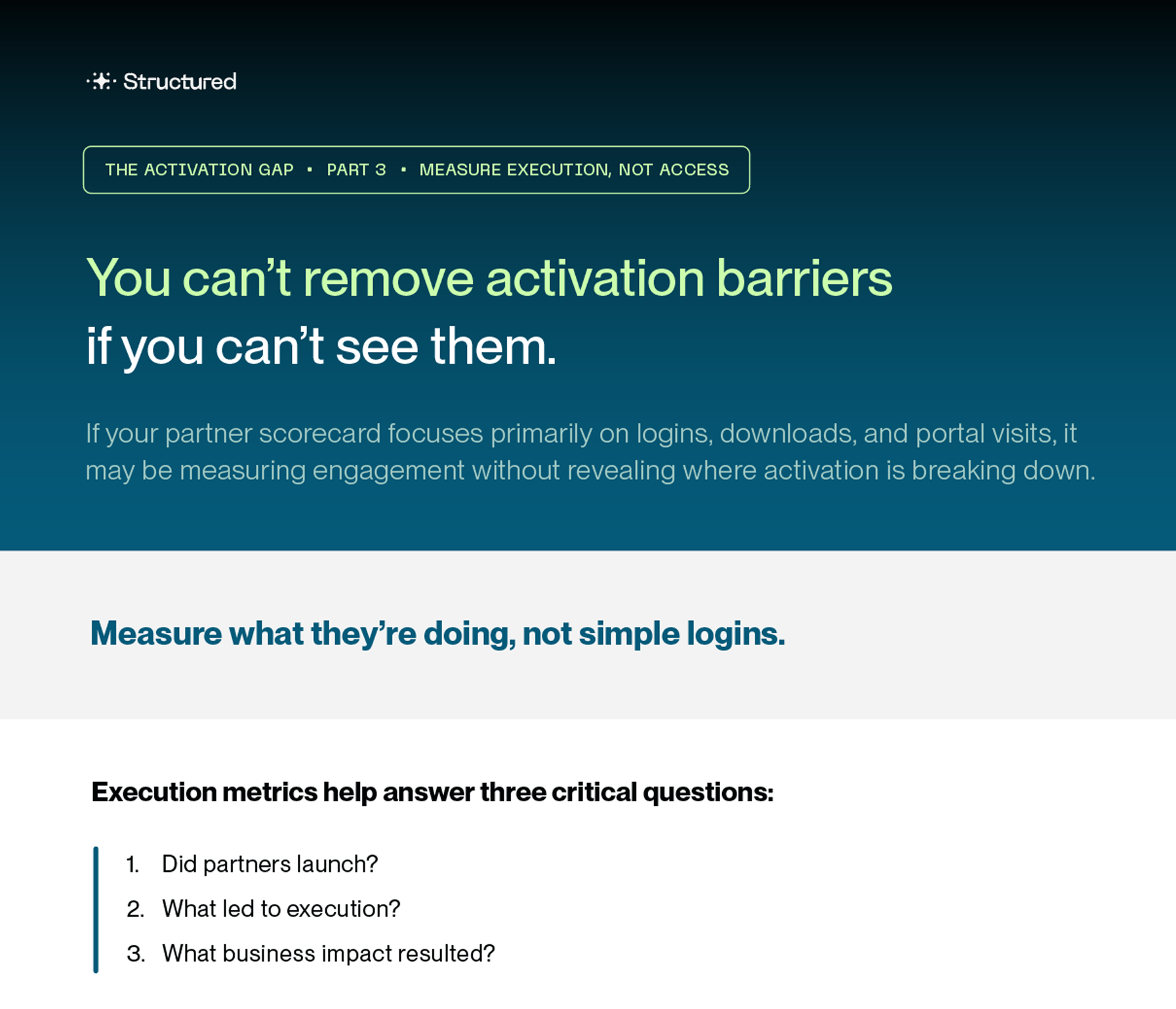
Execution metrics start from a different question. Rather than asking whether partners engaged, they ask whether partners launched, and what followed. They answer three questions engagement metrics do not answer on their own.
Did partners launch?
The most basic question is also the most telling. A traditional scorecard counts logins and page visits. An execution-focused one counts campaigns launched per active partner. That shift moves the measure from presence to output: not how many partners looked, but how many acted.
What led to execution?
Download counts tell you what drew attention, not what was put to work. An execution view asks which content appeared in launched campaigns. That connects specific assets to real market activity, showing where to concentrate investment and which materials are downloaded often but rarely used.
What business impact resulted?
The final question is the one the wider business cares about. A traditional approach counts partners and portal coverage. An execution approach looks at pipeline connected to partner-run campaigns, the difference between knowing how many partners are enrolled and knowing what the program helps produce.
A note of realism belongs here. Channel attribution is rarely clean, and few organizations can tie every partner activity to revenue. The practical goal is to connect launches to partner-sourced or partner-influenced pipeline where the data allows, and to build that picture over time rather than expecting it on day one.
Why This Reframing Matters
Traditional metrics show which partners engaged. Execution metrics show which partners launched. Both belong on the scorecard, but only the second tells you whether the program is doing its job.
Their practical value is that they make the activation gap specific. Instead of a vague sense that activation is low, you can see where it breaks. Three views do most of the work.
The first is knowing what drives launches. When you can see which campaigns and assets appear most often in partner-run campaigns, you invest in what leads to action rather than what merely attracts clicks.
The second is seeing where partners stall. Tracking drop-off across discovery, customization, localization, and launch setup ties measurement straight back to the setup tax: a bottleneck you can locate is a bottleneck you can remove.
The third is connecting launches to outcomes. Where pipeline can be traced to partner-run campaigns, program performance and channel ROI can be discussed in terms the rest of the business already uses.

WATCH THE WEBINAR
Measurement turns the activation gap from a vague concern into a solvable problem. Watch the Activation Gap webinar to see how organizations close the gap between access and execution.
Auditing Your Own Scorecard
A simple exercise makes this concrete. Pull your current partner scorecard and go through it metric by metric, asking of each one: does this measure access or a launch? Count how many fall on each side.
Many teams find the scorecard leans heavily toward access. Treat that tilt as information rather than a verdict. It means the program can see participation clearly and launches barely at all. The most effective scorecards hold both: engagement metrics to show who is participating, execution metrics to show who is launching and what follows.
Engagement metrics keep their place. What changes is their job. They describe interest, while execution metrics describe results, and set side by side they let the scorecard reveal the activation gap instead of hiding it.
Practical Takeaways for Channel Marketing Teams
- Audit your scorecard and count how many metrics measure access versus launches.
- Add one execution metric to each layer: campaigns launched, content used in launches, and pipeline connected to partner-run campaigns where trackable.
- Compare your most downloaded assets against the content that actually appears in launched campaigns.
- Track partner drop-off across discovery, customization, localization, and launch setup.
- Build revenue visibility gradually, connecting launches to partner-sourced or partner-influenced pipeline where the data supports it.
From Access to Execution
Across this series the argument has moved in one direction. Access alone does not create activation. Setup is where partners stall. And a barrier you cannot see is a barrier you cannot remove. Measurement ties the picture together and turns the first two ideas into something a team can act on.
The most successful partner programs do more than provide access to content. They cut the work before the work, watch where partners get stuck, and help them move from decision to launch. Activation is not measured by what partners can reach. It is measured by what they launch and, where it can be tracked, what that activity contributes to the business.
Previous The Setup Tax: Why Partners Stall Before Campaign Launch