
By Stacey Epstein | CEO, Structured
For years, partner marketing teams have invested heavily in content, campaigns, training, and enablement. Yet many organizations still face the same problem: partners are not executing at the level needed to drive consistent pipeline growth.
The issue is rarely a lack of resources as most partner ecosystems already have content libraries, campaign assets, MDF programs, and partner portals. The challenge is turning those resources into action across hundreds or thousands of independent partners.
As ecosystems grow, traditional approaches become harder to scale. Manual processes, approval cycles, localization requests, and disconnected systems create friction that slows execution and limits participation.
This is where the discussion around AI marketing vs. traditional marketing becomes relevant. The difference is not simply the use of new technology. It is a shift in how campaigns move from strategy to execution.
Organizations relying on manual processes often struggle to scale partner engagement. AI-driven execution models create new opportunities to activate partners, accelerate campaigns, and improve visibility into performance.
What Is AI Marketing vs Traditional Marketing?
At its core, traditional marketing is built around centralized execution. Internal teams develop campaigns, create content, manage approvals, and oversee deployment. This model works when one team controls most marketing activity.
Partner ecosystems create a different environment.
Execution is no longer centralized. Campaigns must be adapted, localized, customized, and launched across a network of independent organizations with different resources, audiences, and market priorities.
AI-Driven channel marketing introduces automation and intelligence directly into the execution process. Rather than requiring partners to assemble campaigns manually, locate assets, customize content, and manage multiple workflows, AI reduces the effort required to launch marketing initiatives.
The key distinction is that traditional approaches focus on managing campaigns, while AI-driven systems enable execution across distributed partner ecosystems. That difference has significant implications for adoption, scalability, and revenue generation.
Why Traditional Marketing Breaks Down in Partner Ecosystems
Many partner marketing programs still rely on processes originally designed for centralized marketing organizations.
In those environments, campaigns move through workflows controlled by internal teams. Content creation, approvals, branding, localization, and deployment all happen within a structured process managed by dedicated resources.
Partner ecosystems operate differently.
Partners often need to move quickly. They need content tailored to their audience, messaging localized for their market, co-branded materials, and campaigns aligned with their business priorities.
When every step requires manual vendor support, execution slows. Approval processes create delays. Content localization becomes resource-intensive. Campaign customization requires added effort.
As partner networks expand, the workload placed on vendor marketing teams grows quickly. The result is lower adoption, slower launches, inconsistent execution, and limited visibility into performance.
These challenges are not caused by a lack of partner interest. More often, they are the result of systems that make execution difficult.
How AI Marketing Changes the Execution Model
AI changes partner marketing by reducing the operational complexity that prevents campaigns from reaching the market.
Instead of requiring partners to assemble campaigns manually, AI can automate many of the tasks that slow execution. Content recommendations, branding, localization, and deployment can all be streamlined through intelligent workflows. Partners can move from planning to execution with less reliance on vendor-side resources.
AI also enables greater consistency across partner ecosystems. Campaigns can stay aligned with brand standards while still allowing for customization by region, audience, industry, or market segment. The result is a more scalable execution model.
Marketing teams also spend less time managing operational bottlenecks and more time focusing on strategy, optimization, and performance. Most importantly, partners are able to execute more frequently and with less friction.
Key Differences Between AI Marketing and Traditional Marketing
Execution Speed
Traditional campaign deployment often requires multiple manual steps. Content must be reviewed, customized, approved, and distributed before a campaign can launch. AI reduces those delays by automating many of the activities involved in campaign creation and deployment. Partners can move from planning to launch much faster.
Personalization and Localization
Personalization is increasingly important, but it becomes difficult to scale through manual processes. Traditional methods often require significant time and resources to adapt campaigns for different audiences and markets. AI can automate personalization and localization, helping partners create relevant campaigns without adding operational burden.
Partner Enablement
In many traditional environments, partners remain dependent on vendor teams for campaign support. They need help finding content, adapting messaging, and preparing campaigns for launch. AI reduces that dependency through self-service execution. Partners gain access to tools that help them launch campaigns more independently while maintaining alignment with brand standards.
Scalability
Traditional execution models become increasingly difficult to manage as ecosystems grow. More partners typically require more support, more resources, and more coordination. AI enables organizations to scale execution without increasing complexity at the same rate. Campaign creation and deployment can expand across larger partner networks without creating the same level of operational strain.
Measurement and Optimization
Many organizations struggle to connect partner activity to business outcomes. Reporting is often fragmented, delayed, or incomplete. AI improves visibility by creating stronger connections between execution, engagement, pipeline, and revenue. Marketing teams gain better insight into what partners are launching and which activities generate results.
The Role of AI in Partner-Executed Campaigns
The most effective partner marketing programs make execution easier for partners. They do not require partners to move through slow, layered workflows before taking any action.
AI helps bridge the gap between marketing strategy and execution. Rather than asking partners to determine which campaigns to launch, which assets to use, and how to adapt them for their market, AI can provide recommendations, content, and next steps that make the process easier to act on.
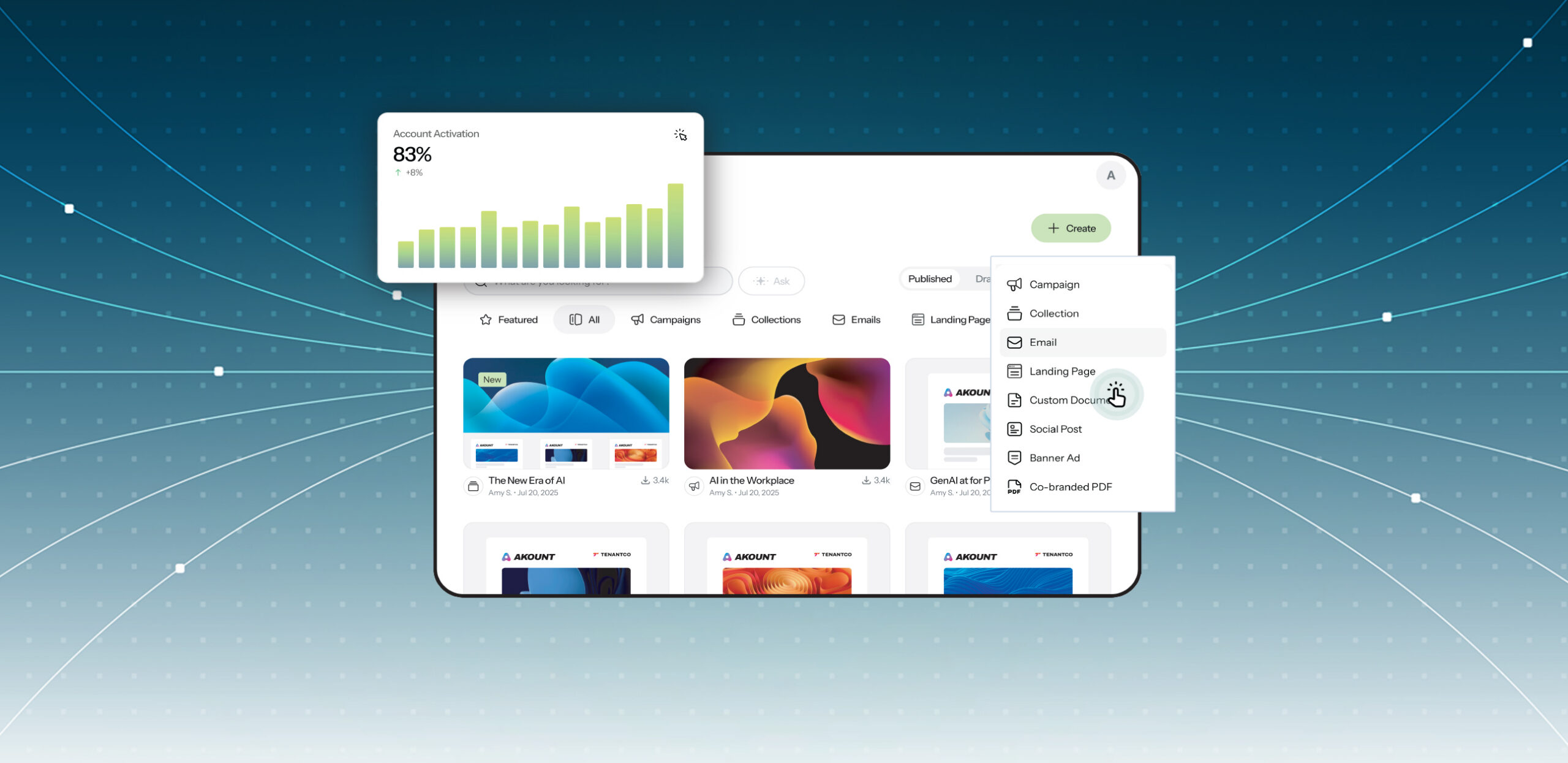
For example, partners can use co-branded campaign execution to launch branded marketing initiatives tailored to their local audience without creating assets from scratch. Organizations can also use AI-powered content creation and localization to adapt messaging for different regions, industries, and customer segments while reducing the manual effort typically required to support those activities.
The objective is not just automation. It is removing the friction that keeps partners from executing campaigns and bringing more marketing programs to market.
From AI Adoption to Partner-Sourced Revenue
AI adoption only matters when it changes what partners are able to execute.
In partner marketing, the path to revenue starts with action. Partners need to launch campaigns, reach buyers, generate engagement, and create opportunities that can be measured. If AI does not make those steps easier, faster, or more uniform, it becomes another technology investment with limited impact.
Many organizations can track the content they created, the campaigns they made available, and the partners they enabled. What they often lack is a clear view into what partners actually launched, which campaigns performed, and how those activities contributed to pipeline.
AI helps close that gap by connecting execution data with campaign performance. As more partners participate, organizations gain stronger visibility into what is working across regions, segments, and partner types. Programs focused on partner demand generation become more effective because teams can optimize based on real activity, not assumptions.
The progression is simple: more execution creates more participation, more participation creates more insight, and more insight creates a stronger path to partner-sourced revenue.
When to Move from Traditional to AI Marketing
Most organizations do not outgrow traditional marketing models all at once. The signs usually appear gradually as partner ecosystems expand, localization requests increase, and campaign launches take longer. Internal teams may also be spending more time supporting execution than improving strategy.
Many organizations respond by adding resources, but that often provides only temporary relief. The deeper issue is complexity.
Organizations should begin evaluating AI-driven approaches when partner execution becomes difficult to scale, campaign launches depend too heavily on internal teams, or visibility into performance remains limited. These are signs that the operating model is no longer aligned with the needs of a modern partner ecosystem.
Why AI-Native Platforms Deliver Better Outcomes
Many marketing technologies now include AI capabilities. However, not all AI marketing platforms are designed to address the execution challenges that exist within partner ecosystems. Simply adding AI features does not create a more effective execution model.
In many environments, AI is introduced into workflows that remain heavily dependent on manual processes, approvals, and disconnected systems. As a result, execution bottlenecks often remain in place even as new technology is added.
AI-native platforms are built differently. Intelligence serves as the basis that connects content, campaigns, partner activity, analytics, and execution within a unified system. This creates a more direct path from planning and insight to action.
For partner marketing teams, the value goes far deeper than operational efficiency. Partners gain a simpler way to launch campaigns, vendors gain greater visibility into performance, and marketing organizations can scale execution across their ecosystems without creating additional operational demands.
Why Structured
Structured was built to solve the execution challenges partner marketing teams face every day. Our platform helps partners create, localize, customize, and launch campaigns without the friction associated with traditional workflows.
By combining AI-driven execution with visibility into performance and outcomes, Structured helps organizations activate more partners and understand what is driving results. This gives marketing teams a clearer path from partner enablement to partner action, helping more campaigns reach the market and generate measurable impact.
The goal is not merely to make campaigns available faster. It is to increase execution across the ecosystem, improve partner participation, and create measurable business impact.
Going forward, the success of partner marketing won’t be determined by how many campaigns are created. It will be determined by how many campaigns partners launch that generate actual results.
Register for the live session: May 21, 2026 | 12:00 PM EST | 30 minutes |

Bring your own program challenges. This is a working session for channel leaders who are tired of explaining low execution numbers, not a product demo.